





Contact
Universität Siegen,
Fakultät IV/Department Physik
Theoretische Physik 1
Walter-Flex-Straße 3
57072 Siegen, Germany
Office: ENC B-121
Tel.: +49 271 740-3890 or 3840
Mail: mannel@physik.uni-siegen.de
Field of Research
The Standard Model of particle physics (SM) is one of the most successful theories ever. It describes three fundamental interactions (strong, electromagnetic and weak) between the fundamental building blocks of matter (quarks and leptons), based on a spontaneously broken local symmetry. As of now (2026), all data gathered in terrestrial experiments, covering energy scales for zero to 100 GeV, are compatible with the SM, including observables that can be predicted at enormous precision as well as can be measured with extreme accuracy. These precision observables even test the SM at the quantum level.
There are various reasons to assume that the SM is not the fundamental theory of nature. On the one hand, the structure of the SM seems to be quite contrived, involving a sizable set of parameters which are not determined by the theory. On the other hand, the fourth force, namely gravity in the form of general relativity, cannot be included into the framework in a consistent way. This may be related to the fact, that the observation of “dark matter” and “dark energy”, which is seen in cosmological observations and in astrophysics, cannot be included in the SM.
Another mystery is the appearance of three almost identical copies of particles, grouped into three generations, which contain two lepton flavors (a charged lepton and an neutrino) and two quark flavors (an up-type and a down type quark) each. The only difference between the particles in the different generations is their masses and their coupling to the charged current of weak interactions, where the latter is encoded in the CKM matrix.
Understanding the origin of this triplication of the particle spectrum is at the heart of quark flavor physics. In particular, processes with bottom- and charm-quarks have been investigated intensively over the last two decades and will remain to be a major part of contemporary particle physics. This includes, on the one hand, dedicated large scale experiments with bottom and charm hadrons all around the world, but also intense efforts to improve the theoretical tools to match up with the increasing accuracy of the data. The group in Siegen has contributed to these theoretical efforts significantly over the last two decades. The two main theoretical tools are effective field theories and QCD sum rules, which have been developed as well as applied to obtain phenomenologically relevant results.
Over the last three decades, the flavor sector of the SM has been investigated in detail. On the one hand, an enormous amount of data has been collected, which allowed us to test the flavor structure of the SM in great detail. On the other hand, in order to extract fundamental parameters of the SM with high precision, vast theoretical efforts have been made, which resulted in a precision test of the predictions of the SM for flavor processes. One set of fundamental parameters are the entries in the CKM matrix
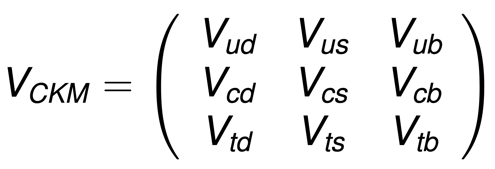
where Vqq´ parametrizes the strength of the weak transition q → q´. The SM predicts this matrix to be unitary, which implies the relation

which can be depicted as a triangle in the complex plane. Various experiments can be used to constrain sides and angles of this triangle, and the evolution of these constraints over time nicely illustrates the progress that has been made in flavor physics
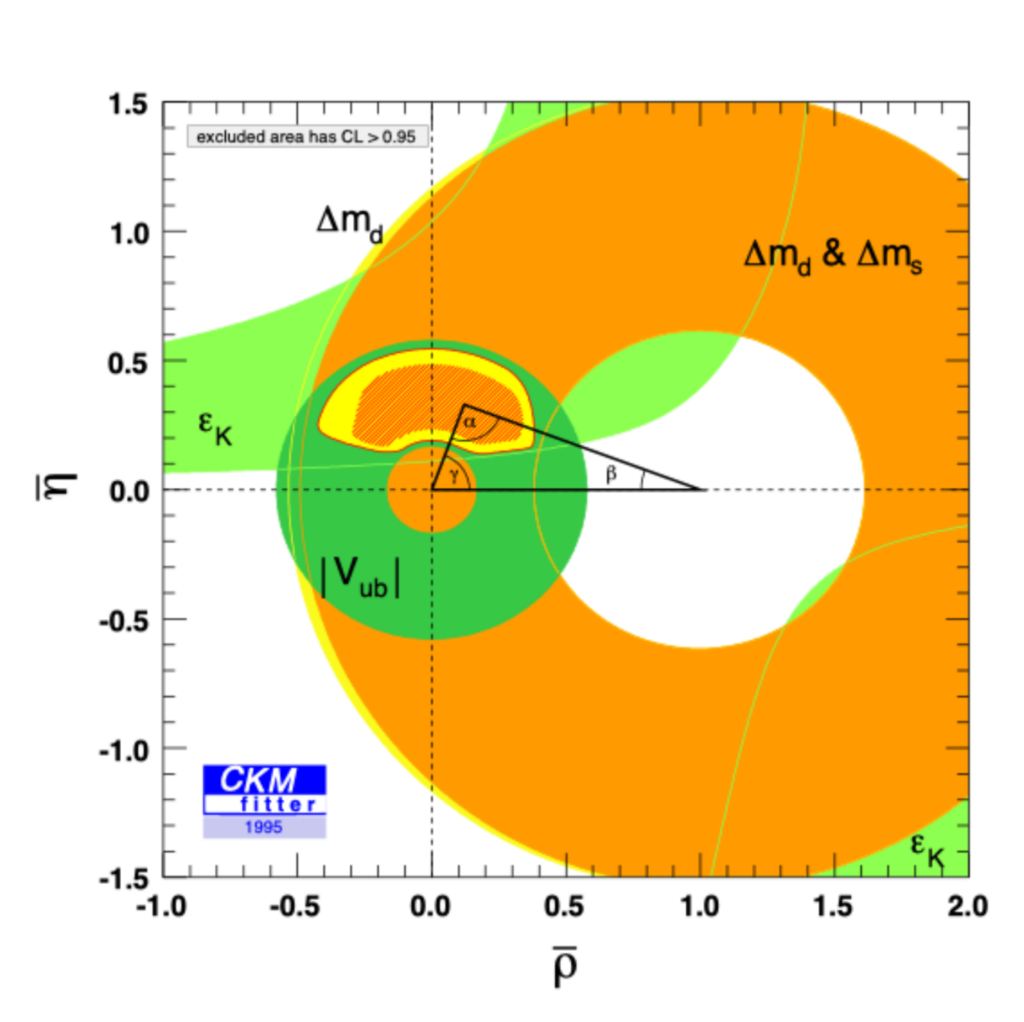
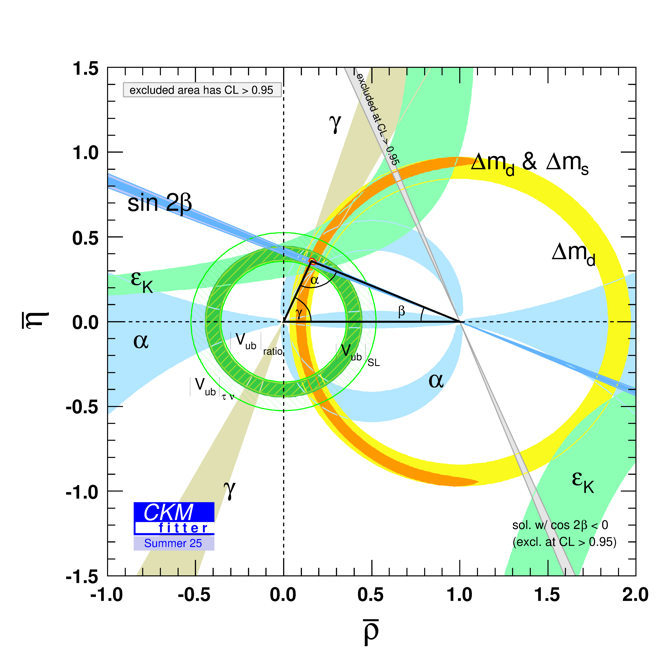
The left panel describes the situation of this unitarity triangle in the year 1995, while the left panel shows the situation as of 2025. Overall, the flavor structure of the SM encoded by the CKM matrix in in the meantime as well established and tested at a level of precision that can be compared to the one for the gauge sector.
Key Words
- Flavor Physics
- Heavy Quark Effective Theory
- Heavy Quark Expansion
- QCD (Light-cone) sum rules
- Bottom Hadron decays
Third Party Funding
| Cluster of Excellence EXC 3107: Color meets Flavor Founding member and Member of the Steering Committee Coordinator of Research Area 2 “Flavor Physics” |  |
| CRC TRR 257: Particle Physics Phenomenology after the Higgs Discovery Co Spokeperson for Siegen (1st and 2nd funding period) PI of Project C1a: Inclusive semi-leptonic, rare and radiative decays PI of Project C2a: Hadronic Matrix Elements and exclusive semi-leptonic decays |  |
| Research Unit FOR 1873: Quark Flavor Physics and Effective Field Theories Spokesperson and PI of Project 1: Precision Heavy Quark Expansion (Ended 2019) |  |
| BMBF Collaborative Research FSP LHCb (until 2019) |  |
Group Members (Status Summer 2026)
- Alexander Khodjamirian (apl. Professor)
- Alexei Pivovarov (apl. Professor)
- Björn Lange (akad. Rat)
- Anshika Bansal (PostDoc)
- Ian Crosby Conget (Masterstudent)
- Daniel Schneider (Masterstudent)
Selection of High Impact Publications
- Three-body non-leptonic B decays and QCD factorization
S. Kränkl, T. Mannel, J. Virto, Nucl. Phys. B 899 (2015) 247–264.
arXiv:1505.04111 | DOI: 10.1016/j.nuclphysb.2015.08.004 - B → Kℓ⁺ℓ⁻ decay at large hadronic recoil
A. Khodjamirian, T. Mannel, Y. M. Wang, JHEP 02 (2013) 010.
arXiv:1211.0234 | DOI: 10.1007/JHEP02(2013)010 - B → πℓνℓ Width and |Vub| from QCD Light-Cone Sum Rules
A. Khodjamirian, T. Mannel, N. Offen, Y. M. Wang, Phys. Rev. D 83 (2011) 094031.
arXiv:1103.2655 | DOI: 10.1103/PhysRevD.83.094031 - Charm-loop effect in B → K*ℓ⁺ℓ⁻ and B → K*γ
A. Khodjamirian, T. Mannel, A. A. Pivovarov, Y. M. Wang, JHEP 09 (2010) 089.
arXiv:1006.4945 | DOI: 10.1007/JHEP09(2010)089 - Precision Physics with Bs0 → J/ψφ at the LHC: The Quest for New Physics
S. Faller, R. Fleischer, T. Mannel, Phys. Rev. D 79 (2009) 014005.
arXiv:0810.4248 | DOI: 10.1103/PhysRevD.79.014005 - The Golden Modes B0 → J/ψKS,L in the Era of Precision Flavour Physics
S. Faller, M. Jung, R. Fleischer, T. Mannel, Phys. Rev. D 79 (2009) 014030.
arXiv:0809.0842 | DOI: 10.1103/PhysRevD.79.014030 - Form factors from light-cone sum rules with B-meson distribution amplitudes
A. Khodjamirian, T. Mannel, N. Offen, Phys. Rev. D 75 (2007) 054013.
arXiv:hep-ph/0611193 | DOI: 10.1103/PhysRevD.75.054013 - B-meson distribution amplitude from the B → π form factor
A. Khodjamirian, T. Mannel, N. Offen, Phys. Lett. B 620 (2005) 52–60.
arXiv:hep-ph/0504091 | DOI: 10.1016/j.physletb.2005.06.021 - Imprecated, yet impeccable: On the theoretical evaluation of Γ(B → Xcℓν)
D. Benson, I. I. Bigi, T. Mannel, N. Uraltsev, Nucl. Phys. B 665 (2003) 367–401.
arXiv:hep-ph/0302262 | DOI: 10.1016/S0550-3213(03)00452-8 - Light cone distribution functions for B decays at subleading order in 1/mb
C. W. Bauer, M. E. Luke, T. Mannel, Phys. Rev. D 68 (2003) 094001.
arXiv:hep-ph/0102089 | DOI: 10.1103/PhysRevD.68.094001 - Penguin topologies, rescattering effects and penguin hunting with B → KK̄ and B± → π±K
A. J. Buras, R. Fleischer, T. Mannel, Nucl. Phys. B 533 (1998) 3–24.
arXiv:hep-ph/9711262 | DOI: 10.1016/S0550-3213(98)00506-9 - Constraining the CKM angle γ and penguin contributions through combined B → πK branching ratios
R. Fleischer, T. Mannel, Phys. Rev. D 57 (1998) 2752–2759.
arXiv:hep-ph/9704423 | DOI: 10.1103/PhysRevD.57.2752 - Towards a model independent analysis of rare B decays
A. Ali, G. F. Giudice, T. Mannel, Z. Phys. C 67 (1995) 417–432.
arXiv:hep-ph/9408213 | DOI: 10.1007/BF01624585 - Higher order 1/m corrections at zero recoil
T. Mannel, Phys. Rev. D 50 (1994) 428–441.
arXiv:hep-ph/9403249 | DOI: 10.1103/PhysRevD.50.428 - Resummation of nonperturbative corrections to the lepton spectrum in inclusive B → Xℓν decays
T. Mannel, M. Neubert, Phys. Rev. D 50 (1994) 2037–2047.
arXiv:hep-ph/9402288 | DOI: 10.1103/PhysRevD.50.2037 - Operator product expansion for inclusive semileptonic decays in heavy quark effective field theory
T. Mannel, Nucl. Phys. B 413 (1994) 396–412.
arXiv:hep-ph/9308262 | DOI: 10.1016/0550-3213(94)90625-4 - Forward backward asymmetry of dilepton angular distribution in the decay b → sℓ⁺ℓ⁻
A. Ali, T. Mannel, T. Morozumi, Phys. Lett. B 273 (1991) 505–512.
DOI: 10.1016/0370-2693(91)90306-B - A Derivation of the heavy quark effective Lagrangian from QCD
T. Mannel, W. Roberts, Z. Ryzak, Nucl. Phys. B 368 (1992) 204–217.
DOI: 10.1016/0550-3213(92)90204-O - Exclusive rare B decays in the heavy quark limit
A. Ali, T. Mannel, Phys. Lett. B 264 (1991) 447–454.
DOI: 10.1016/0370-2693(91)90376-2 - Baryons in the heavy quark effective theory
T. Mannel, W. Roberts, Z. Ryzak, Nucl. Phys. B 355 (1991) 38–53.
DOI: 10.1016/0550-3213(91)90301-D
Teaching
- Summerterm 26: Challenging the Standard Model at LHC (Seminar)
- Winterterm 25/26: Concepts and Phenomena in Particle Physics (Lecture series with tutorials)
CV
- Since 2004: Full Professor at the University of Siegen (Germany)
- 2009 – 2024: Vice Rector of the University of Siegen (Germany)
- 1994 – 2023: Associate Professor at the University of Karlsruhe (TH) aka KIT (Germany)
- 1993 – 1994: Scientific Associate at CERN-TH, Geneva (Switzerland)
- 1991 – 1992: PostDoc at DESY-TH, Hamburg (Germany)
- 1989 – 1990: PostDoc at Harvard University, Cambridge, MA (USA)
- 1987 – 1989: PostDoc at the Techn. Univ. Darmstadt (Germany)
- 1984 – 1987: PhD from Techn. Univ. Darmstadt (Germany)
- 1977 – 1983: Diploma Student at the Techn. Univ. Darmstadt (Germany)